Global trade underpins the modern economy. Every day, millions of shipments cross borders, connecting producers, suppliers, and consumers across continents. According to the World Trade Organization, global merchandise trade now exceeds $30 trillion annually, with trade finance supporting a significant portion of these flows.
Yet behind every shipment sits a complex ecosystem of documentation, compliance checks, and regulatory scrutiny. For financial institutions facilitating these transactions, managing risk within this ecosystem has become increasingly challenging.
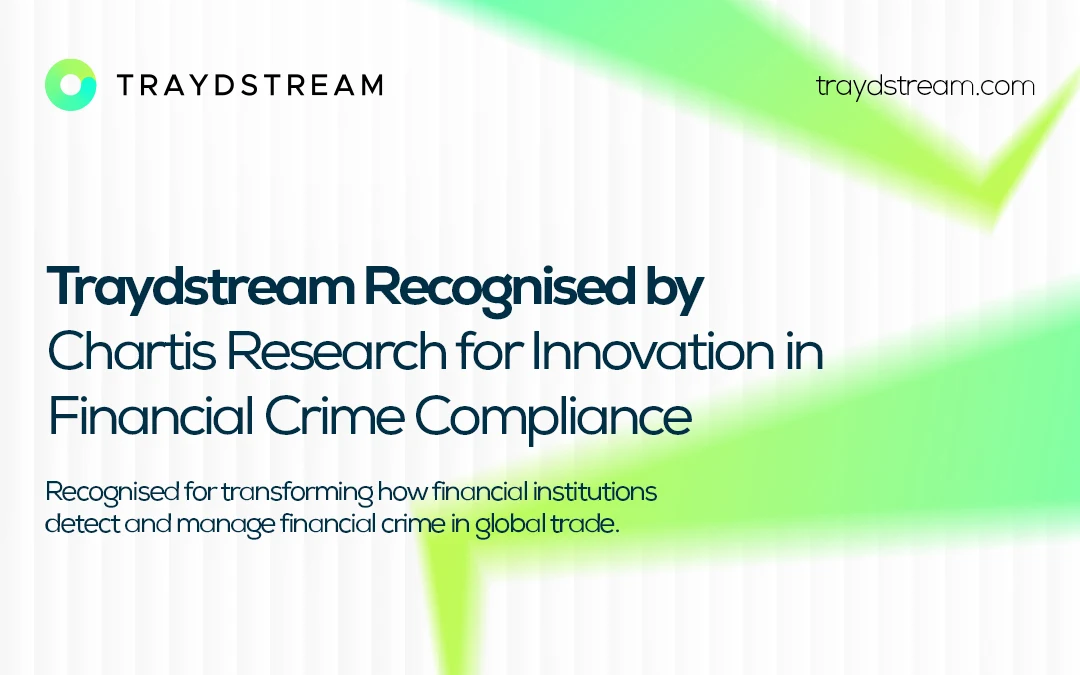
It is against this backdrop that Traydstream was recently recognised in the Financial Crime and Compliance 50, published by Chartis Research, a respected global research firm specialising in risk and regulatory technology.
The recognition reflects a broader industry reality: trade finance is emerging as one of the most complex areas for financial crime and compliance management, and technology is becoming essential to addressing the challenge.
The Unique Risk Profile of Trade Finance
Trade finance differs from many other areas of banking because it is fundamentally document-driven. A single transaction can involve numerous documents including commercial invoices, bills of lading, packing lists, certificates of origin, and insurance documentation.
Each document contains critical information that banks must verify before financing a transaction or releasing payment.
These checks are not simply operational tasks. They are an essential part of the risk management framework governing international trade. Banks must ensure that transactions comply with international trade rules, including those set by the International Chamber of Commerce, such as UCP 600, which governs the examination of documents under letters of credit.
Historically, document examination has relied heavily on manual processes carried out by specialist trade operations teams. But as trade volumes increase and regulatory expectations rise, these manual processes are becoming increasingly difficult to sustain.
The Challenge of Trade-Based Financial Crime
One of the most significant risks within trade finance is trade-based money laundering (TBML). Unlike other forms of financial crime, TBML exploits legitimate trade transactions to move illicit funds across borders.
According to the Financial Action Task Force, TBML remains one of the most difficult financial crime typologies for institutions to detect due to the complexity and scale of global trade.
The United Nations Office on Drugs and Crime estimates that 2–5% of global GDP — equivalent to up to $2 trillion annually — may be linked to illicit financial flows, with trade manipulation playing a significant role.
Common TBML techniques include:
- Over- or under-invoicing goods
- Misrepresenting the quality or quantity of shipments
- Falsifying shipping documentation
- Routing goods through multiple jurisdictions to obscure origin
- Obtaining financing multiple times against the same trade transaction
Detecting these activities requires banks to analyse detailed information across multiple documents and compare it against transaction data, trade rules, and compliance frameworks.
When this analysis relies solely on manual review, identifying suspicious patterns becomes extremely challenging.
Rising Regulatory Expectations
The regulatory environment surrounding trade finance has grown significantly more complex in recent years.
Financial institutions involved in global trade must now navigate a wide range of obligations including:
- Anti-Money Laundering (AML) requirements
- Counter-Terrorist Financing (CTF) controls
- Sanctions screening
- Export controls and dual-use goods monitoring
- Supply chain transparency regulations
Sanctions programmes in particular have expanded rapidly in response to geopolitical developments. Banks are expected to ensure that trade transactions do not involve sanctioned entities, restricted goods, or prohibited jurisdictions.
At the same time, regulators expect institutions to maintain clear audit trails, consistent document examination practices, and robust compliance oversight.
For many banks, this combination of regulatory pressure and increasing document volumes is creating significant operational strain.
The Operational Reality for Trade Finance Teams
Despite the scale and importance of trade finance, many institutions still rely on operational processes that were designed decades ago.
Trade operations teams frequently examine documents line by line, comparing details across multiple forms to identify discrepancies. While this approach reflects deep expertise within trade finance departments, it is also labour-intensive and difficult to scale.
As global trade continues to expand, institutions face several operational challenges:
Document volumes are increasing.
Processing times can slow as complexity grows.
Human error becomes harder to avoid when reviewing large volumes of documents.
Identifying patterns across transactions — which may indicate financial crime — becomes extremely difficult.
This operational burden is one of the key drivers behind the growing adoption of digitisation and AI within trade finance operations.
Technology Is Transforming Trade Compliance
Advances in artificial intelligence and document digitisation are enabling financial institutions to rethink how trade finance processes operate.
Modern platforms can extract structured data from complex trade documents, allowing banks to analyse information automatically and check it against trade rules, compliance frameworks, and internal policies.
Instead of manually reviewing documents in isolation, institutions can begin to analyse trade transactions as structured data sets, providing deeper visibility into discrepancies, anomalies, and potential risk indicators.
As Nese Salincakli at Traydstream explains:
“Trade finance sits at the intersection of global commerce and financial crime risk. The challenge for banks has always been how to analyse large volumes of complex documentation quickly and consistently. By applying AI to trade document examination, institutions can digitise this information and identify discrepancies or potential risks far more efficiently, while still keeping human expertise at the centre of decision making.”
This combination of technology and domain expertise is becoming increasingly important as banks seek to modernise their trade operations.
A Broader Industry Shift
Recognition in the Financial Crime and Compliance 50 by Chartis Research highlights a wider transformation taking place across the trade finance industry.
Financial institutions are increasingly investing in technologies that enable them to:
- Automate document examination
- Improve consistency in compliance processes
- Detect anomalies earlier in the transaction lifecycle
- Reduce operational bottlenecks
- Strengthen audit and regulatory reporting capabilities
As trade flows continue to grow and regulatory scrutiny intensifies, the ability to combine advanced analytics with deep trade expertise will become critical.
The Future of Compliant Global Trade
Trade finance remains a vital enabler of global commerce. But ensuring that trade flows remain secure, transparent, and compliant requires new approaches to managing risk.
Digitisation offers a pathway toward a more resilient trade ecosystem where documentation can be processed faster, compliance checks can be applied more consistently, and financial institutions gain greater visibility into the transactions they support.
As the industry continues to evolve, technology will play an increasingly important role in helping banks manage complexity while safeguarding the integrity of global trade.
Recognition such as the Financial Crime and Compliance 50 reflects this momentum — and the growing importance of innovation in strengthening compliance across the trade finance landscape.